Perhaps unbeknownst to some people who know me now, I started my career as a designer ‘on the tools’ almost 30 years ago. Back then, when I was young and inexperienced, every brand project was treated the same way. You came in, you changed everything, and you called it a rebrand. The goal was transformation. The driver was creative ambition, personal taste, building my portfolio and the quiet satisfaction of replacing something with something better.
That mindset did not last.
Over time, working on with more owners and founders, and thinking harder about what actually moves the needle for a business, the question shifted. It stopped being “what would I like to redesign?” and became “what does this brand actually need?” And those are very different questions.
Sometimes the answer is evolution. Sometimes it is revolution. But the right answer is never the same for every business, and it is not determined before the work begins.
The case against radical change
The argument for caution around rebranding is well established, and it is grounded in solid research.
Marketing science, particularly the work coming out of the Ehrenberg-Bass Institute, tells us that brands grow through mental availability. Consumers need to be able to recognise and recall a brand at the moment of purchase. Distinctive assets, the visual and verbal cues that make a brand immediately identifiable, are the mechanisms through which that recognition operates.
When you remove those cues, you risk destroying memory structures that have taken years and significant spend to build. The consumer no longer connects what they see with what they already know. You are, in effect, starting over.
Tropicana’s packaging redesign is the cautionary tale most marketers reach for. The rebrand had to be reversed after a dramatic sales drop and a consumer backlash. The company had replaced a distinctive, recognisable visual with something clean and generic. In doing so, it removed the very cues that made the product easy to find and easy to choose.
Commentators like Mark Ritson have made this point consistently: for established brands with genuine awareness, radical change is almost always the wrong call. The equity built over time is real, and destroying it is expensive.
This thinking is correct. For large, established brands with strong recognition, brand evolution is almost always the right path.
But most of the businesses I work with are not large, established brands.
The question that changes the calculation
Small and mid-sized businesses often approach a rebrand with the same protective instincts as a global consumer brand. They worry about disrupting what they have built. They hesitate to change too much.
The question worth asking before any of that is:
Do you actually have the brand recognition you think you have?
For many businesses, the honest answer is no. Awareness is lower than assumed. Recognition is inconsistent across different contexts and audiences. The distinctive assets are either absent or so underused they have not taken hold in anyone’s memory.
There is a difference between a brand that has genuinely built equity and a brand that has simply been around for a while. Age and familiarity within a small circle are not the same as meaningful market recognition.
If a business does not have significant equity to protect, the logic behind cautious evolution becomes much weaker. The risk of radical change is lower than assumed, and the opportunity is considerably greater.
The minimum viable brand problem
Most small and mid-sized businesses did not start with a carefully designed brand system. They started with something functional enough to get going.
A logo was needed, so one was made. Colours were chosen, probably quickly. Messaging was cobbled together from what felt right at the time. Over the years, new materials were added, different designers contributed different things, and the brand became a patchwork of decisions made under pressure, at speed, without a coherent strategy behind any of them.
This is what I think of as the minimum viable brand. It is not a failure. It is how most businesses start, and for a period it is entirely appropriate.
But there comes a point, often when the business has grown and is looking to move upmarket, or compete for a different kind of client, where the brand that got the business here is simply not built for where the business wants to go next.
At that point, the question is not whether to protect existing equity. The question is whether the existing brand is capable of doing the work required of it.
Often, it is not.
What revolution actually means
A brand revolution is frequently misunderstood as reckless change. Strategically executed, it is not.
The mindset behind it is more precise than that. It is asking, with genuine honesty: what we have built has got us this far. Is it actually capable of taking us where we want to go next?
If the answer is no, then the brand may need fundamental rethinking, not incremental adjustment. That might mean redefining the positioning, building a new set of distinctive assets, rebuilding the visual identity from a strategic foundation, and creating a system that is coherent rather than accumulated.
None of that is reckless. It is recognition that the brand needs to work differently in order to serve a different ambition.
There is also a practical consideration that rarely gets discussed. The cost of a modest brand change and a significant one are not as different as most people assume. The design and strategy work scales, but the rollout does not. Updating assets, signage, digital presence, collateral, and everything else costs roughly the same whether the underlying change is modest or meaningful. If that investment is going to happen anyway, getting real impact from it is not a luxury. It is basic commercial logic.
The other cost that tends to get overlooked is the cost of the half-measure. Tentative changes that do not solve the underlying problem mean going back and doing it again in a few years. Businesses that pull their punches at this decision point often find themselves cycling through minor updates that never quite land, spending the money repeatedly without ever getting the result. One well-considered revolution, done properly, is almost always cheaper over time than several cautious evolutions that leave the real problem unresolved.
The Tropicana paradox
Tropicana is often cited as proof that rebranding is dangerous. It is worth being more precise about what actually went wrong.
Tropicana did not fail because it changed too much. It failed because it removed distinctiveness. The redesign replaced recognisable, ownable visual cues with something generic. Consumers could no longer find the product on the shelf in the three seconds they typically give to locating a familiar brand. So they moved on to the next option.
The lesson is specific: removing distinctiveness from a brand with genuine, earned recognition is expensive. That lesson is valid. But it is not an argument against revolution. It is an argument against the particular kind of change that strips a brand of what makes it recognisable. A revolution that builds distinctiveness rather than destroys it is a different proposition entirely.
The irony is that Tropicana now arguably needs renewal. The visual language has dated. The category has evolved. Competitors have moved. But the memory of the backlash may be so strong that meaningful change feels off-limits, even when meaningful change is what the brand needs.
Badly executed change can create long-term risk-aversion. And long-term risk-aversion in a changing market is its own form of slow decline.
Brands that stop evolving do not stay still. They gradually become less relevant. The market moves around them.
The process decides, not the brief
One of the things I have come to believe is that the decision between evolution and revolution should not be made before the work begins. It should emerge from the process.
That means starting with strategy, running a rigorous creative exploration, testing ideas against the brand’s ambitions and context, and allowing the right solution to surface through iteration rather than assumption.
A project I worked on with Joya Apples illustrates this. Going in, the gap between the brand strategy, the visual identity, and how the brand was actually expressing itself suggested that a significant rethink was needed. From a strategic perspective, it looked like revolution.
But the situation was more complex. Multiple stakeholders were involved. The existing brand had already been rolled out across parts of the world. People had invested in it, personally and financially, and were understandably reluctant to see it replaced entirely.
Through the process, we landed somewhere more nuanced. The result was, in some ways, a revolution with elements of evolution woven through it. The brief called for retaining the idea of an apple symbol, which is somewhat ironic for an apple brand, where the symbol is arguably the least distinctive thing it could use. But the existing apple graphic was completely redesigned into something new. What we kept was the concept, not the execution. Everything else was rebuilt from the ground up. The identity was not patched. The existing elements were reworked so they functioned within the new strategy. And while some might have described the outcome as an evolution, looking at the before and after it is clearly a revolution.
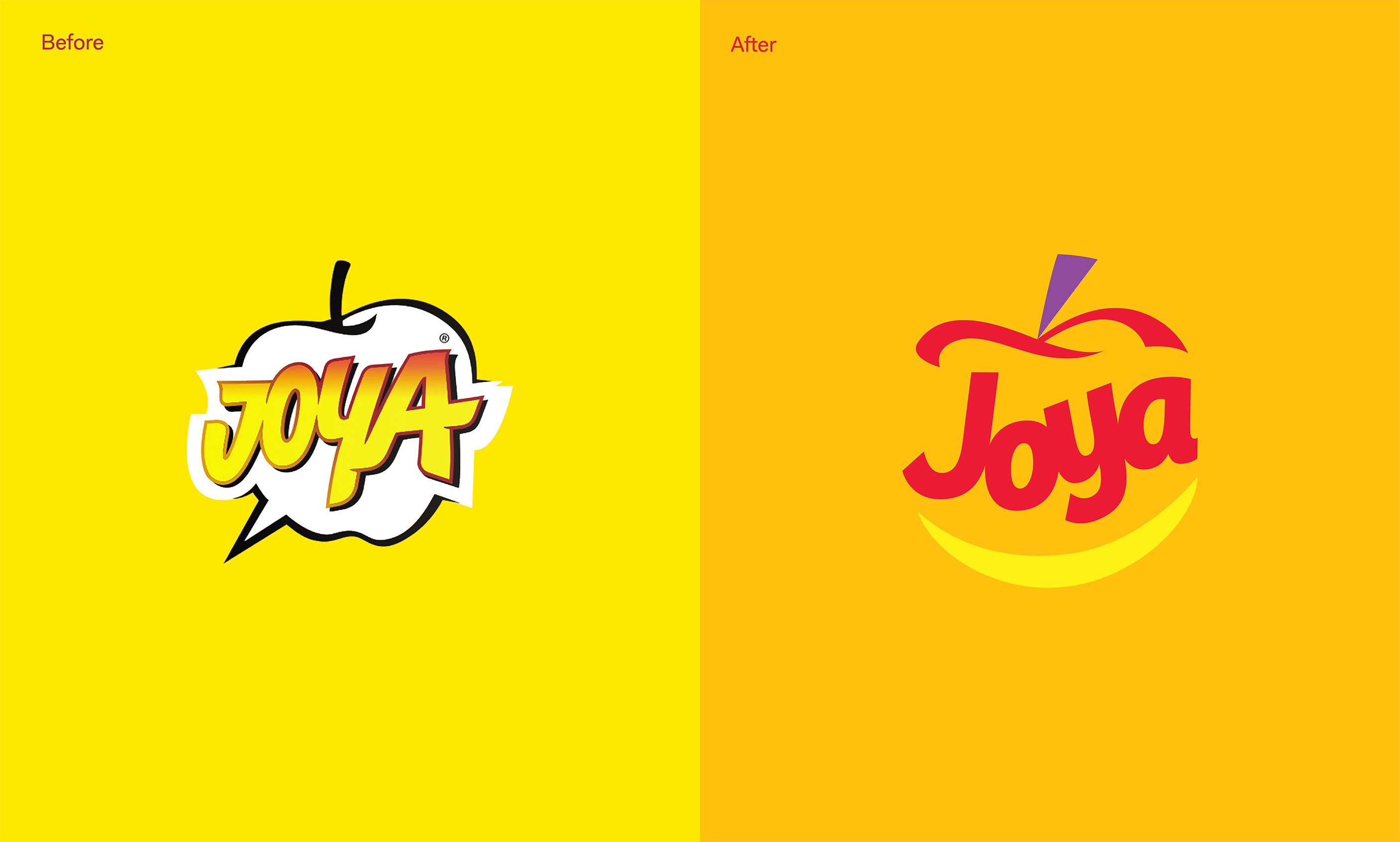
The lesson from that project is not about evolution versus revolution per se. It is about starting with a clear strategy, running an honest creative process, and letting the right answer emerge. In this instance, new market opportunities were energised to try something new, while a fresh upgrade energised existing markets.
One question worth asking first
The debate around rebranding often gets stuck in a binary. Keep it or change it. Protect or refresh. Evolve or revolutionise.
The more useful starting point is an honest assessment of what the brand actually has.
Marketing science is right that equity should be protected. But before protecting it, it is worth establishing whether it genuinely exists in the form and at the scale the business assumes.
For many small and mid-sized businesses, the answer to that question changes the risk calculation entirely. The fear of radical change turns out to be disproportionate to the actual equity at stake. And the opportunity to build something that genuinely works, a brand system built on strategy rather than accumulated decisions, turns out to be considerably more valuable than protecting what is already there.
Do you actually have the brand recognition you think you have?
It is worth being honest about that before you decide.